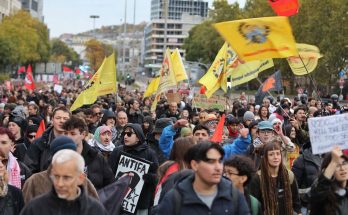
A protester confronts San Jose police as they advance on May 29, 2020 during demonstrations in response to the George Floyd murder in Minneapolis.
A federal appeals court set aside $1.35 million in damages Monday against the city of San Jose and a police officer who shot and wounded a peaceful and unarmed demonstrator in the George Floyd protests because he was standing in a crowd with others who threw bottles at police.
In a 2-1 ruling, the 9th U.S. Circuit Court of Appeals said that although Kyle Johnson posed no threat, Officer James Adgar had a reason to fear violence from other protesters and did not violate any “clearly established” law when he fired projectiles into the crowd in May 2020.
One pellet hit Johnson in the back of his leg, causing blood clots and lung blockage that have kept him on blood-thinning medication ever since. Johnson was then a girls’ basketball coach and a teachers’ assistant.
Damages were awarded by a San Jose jury against the city and Adgar in January 2025 under both federal and state laws, and were upheld by U.S. District Judge Beth Labson Freeman, who presided over the trial. The appeals court said it would decide in later proceedings whether any of the damages were granted solely for violation of California civil rights law, and asked the California Supreme Court how the state law would apply to this case.
Hundreds of people gathered outside San Jose City Hall during nationwide protests against the killing five days earlier of Floyd, a Black man, by a white policeman in Minneapolis who knelt on his neck and back for nearly 10 minutes. A store clerk had accused Floyd of using a counterfeit $20 bill in a purchase. The officer, Derek Chauvin, was convicted of murder.
Adgar said he was aiming his gun at a bottle-thrower and accidentally hit Johnson. But the appeals court said the jury was entitled to find that the officer “could not successfully identify a clear target in the crowd and simply shot in the general direction of someone he saw throwing a bottle.”
“Johnson posed no apparent threat to anyone’s safety, and was neither resisting arrest nor attempting to flee arrest,” Judge Richard Tallman wrote in the majority opinion. “He was, however, part of a crowd of people, some of whom were committing assault on a peace officer.”
And while Adgar used “unreasonable” force against Johnson, Tallman said, the officer did not violate any “clearly established law” and was therefore shielded from damages under the Supreme Court’s doctrine of “qualified immunity,” which protects police from criminal prosecution and civil damages unless federal courts had ruled their conduct illegal in a virtually identical case.
Tallman, whose judicial record is generally conservative, was appointed by President Bill Clinton in 2000 as part of a compromise with Republicans allowing Clinton to make an additional judicial appointment. He was joined in Monday’s ruling by Judge Mark Bennett, appointed by President Donald Trump.
In dissent, Judge Richard Paez, a more liberal Clinton appointee, said the evidence at the trial of Johnson’s lawsuit showed that he “and the protesters near him were acting peacefully.”
That evidence “clearly established the unlawfulness of shooting a projectile weapon capable of causing serious and permanent injury indiscriminately into a group of protestors who did not pose an imminent risk to public safety,” Paez wrote.
Johnson’s lawyers were not immediately available for comment. They could ask the full appeals court for a new hearing before an 11-judge panel.