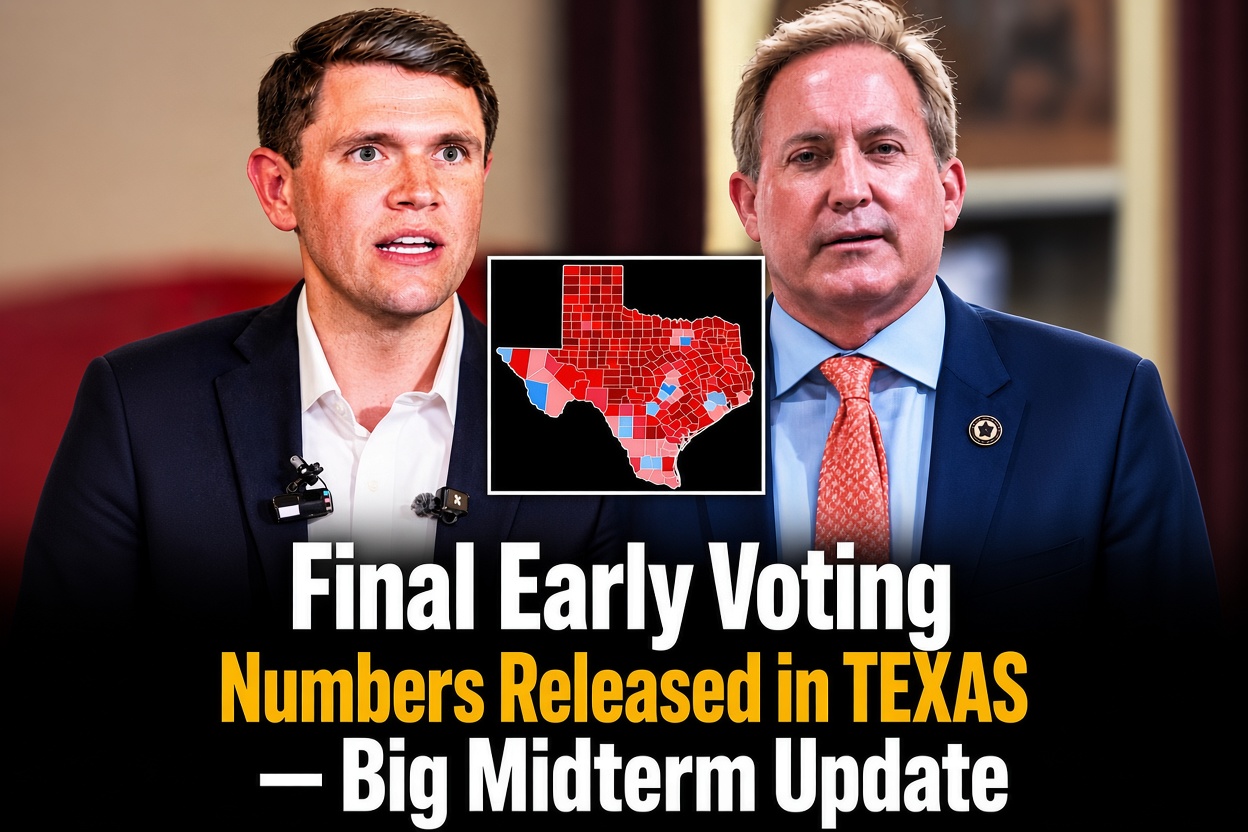
Texas Republicans received an encouraging November 1 early voting estimate showing a substantial modeled advantage ahead of Tuesday’s Senate election.
Election Data Guy’s graphic reports 7,716,859 early and mail ballots in the state.
Its model assigns 4,116,419 ballots to Republicans and 3,488,783 to Democrats, with another 111,657 classified separately.
The difference produces a Republican-modeled firewall of 627,636 ballots.
The graphic estimates final turnout at 54%, with Republicans projected between 50% and 56% of votes.
Democrats are projected between 41% and 47%, according to the analyst’s published ranges.
Texas voters do not register by party, meaning partisan classifications of returned ballots require assumptions.
Republican Attorney General Ken Paxton faces Democratic state Representative James Talarico in the contest for John Cornyn’s seat.
Paxton defeated Cornyn in the Republican nomination battle and received an endorsement from President Donald Trump.
Texas has not elected a Democrat to statewide office since 1994, a historical advantage for Republicans.
Trump also carried Texas comfortably during the 2024 presidential election.
The new model’s Republican advantage increased from 474,470 on October 25 to approximately 627,636 on November 1.
That represents an increase of 153,166 modeled ballots over the intervening week.
Texas has 7,716,859 early votes in the Secretary of State’s final early-voting count, and Republicans hold a 627,636 modelled firewall.
The modelled split sits around 53% R / 45% D. That’s softer for Republicans than their 2024 share (56.0%) and firmer for Democrats than 2024 (42.6%) and 2022 (43.2%). The model’s vote ranges are 50%–56% R and 41%–47% D.
About 306k votes were added since Saturday’s update. Modelled Democratic ballots outpaced Republican ones in that batch, so the Republican firewall narrowed by roughly 28k.
Texas: party shares are modelled (no party registration) — official vote counts by party aren’t known until election day.
— E_DataGuy (@E_DataGuy) November 2, 2026
Republicans nevertheless enter Election Day with formidable national financial resources supporting candidates and voter mobilization.
Trump’s political operation represents a major source of that financial firepower.
His flagship super PAC, MAGA Inc., began September with nearly $416 million in available funds.
Federal disclosures showed MAGA Inc. spending nearly $277 million during a six-week period beginning in September.
That spending includes large transfers to allied organizations rather than exclusively direct advertising purchases.
MAGA Inc. transferred $200 million to No Going Back PAC and $25 million to Safety and Affordability PAC.
The super PAC still held more than $164 million on October 14, according to reported filings.
Those figures describe different reporting dates and should not be added as simultaneous cash balances.
Trump said his broader political network planned more than $400 million in midterm expenditures before Election Day.
That commitment covers advertising, voter contact, rallies, and additional political operations across competitive states.
Trump aligned groups concentrated substantial resources on Texas, Michigan, and Ohio Senate contests.
Reuters reported outside organizations supporting Paxton spent approximately $239 million, compared with roughly $45 million from major Democratic aligned groups.
Texas PAC alone accounted for nearly $149 million in spending supporting the Republican.
The organization was established by Senate Leadership Fund, a major Republican Senate super PAC.
Elon Musk contributed $158 million to Senate Leadership Fund, according to federal filings described by Reuters.
That organization subsequently transferred corresponding amounts to Texas PAC for the contest.
Talarico’s campaign has raised substantial money independently, reporting $64 million collected from July through September.
That fundraising underscores why Republicans cannot assume outside spending automatically guarantees victory.
MAGA Inc also received an $8 million September contribution from casino entrepreneur Steve Wynn.
Stephen Schwarzman and Diane Hendricks each contributed another $5 million, according to federal disclosures.
Major donors give Republicans resources for late advertising, organizing, and election operations.
Yet advertising purchased late can cost considerably more than placements secured earlier in the cycle.
The stakes extend beyond Texas because Republicans currently hold a 53-seat Senate majority.
Democrats would need a net gain of four seats to control the chamber.
This article may contain commentary which reflects the author’s opinion.