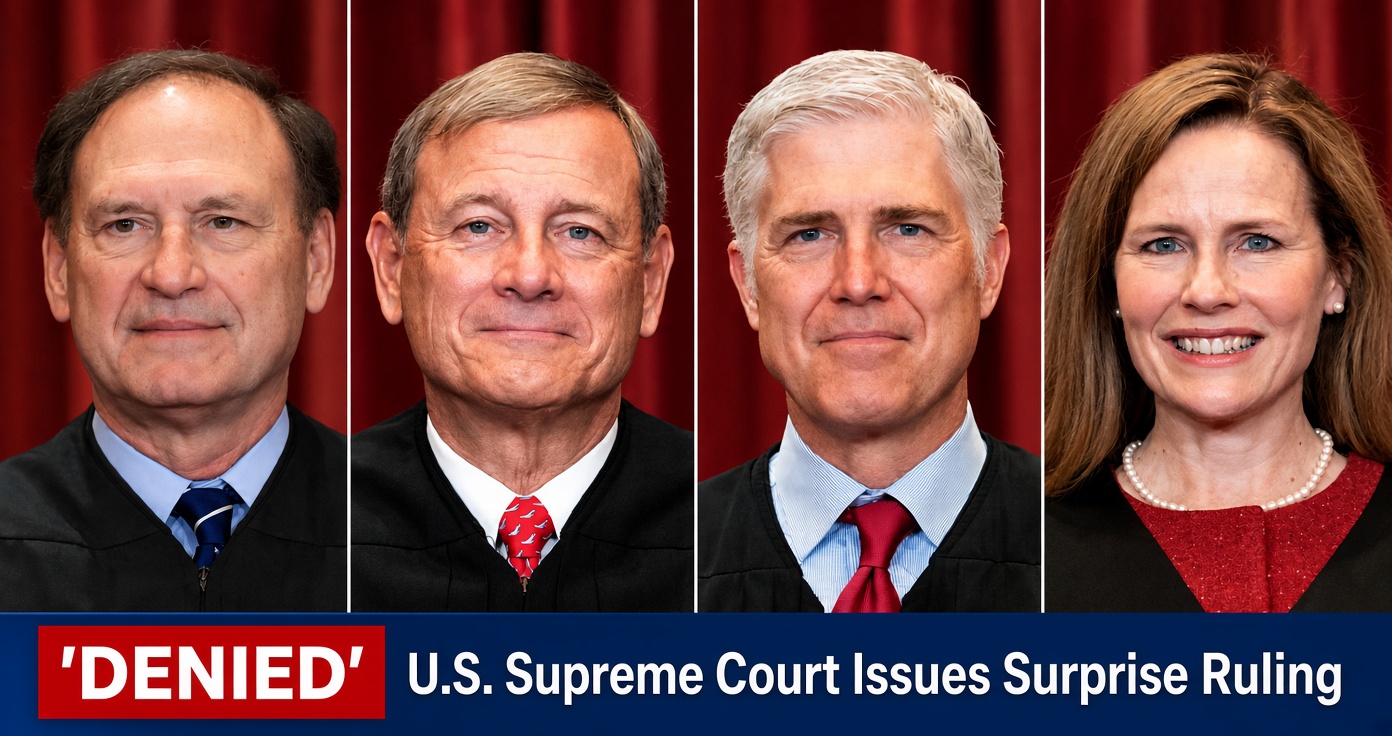
The Supreme Court on Monday rejected an effort by accused 9/11 mastermind Khalid Sheikh Mohammed and two alleged co-conspirators to revive plea agreements that would have spared them the death penalty, clearing another obstacle toward their long-delayed military trial.
The justices declined to hear appeals from Mohammed and co-defendants Mustafa al-Hawsawi and Walid bin Attash, leaving intact a federal appeals court ruling that upheld former Defense Secretary Lloyd Austin’s authority to cancel the agreements.
The Supreme Court did not explain its reasoning, as is customary when denying petitions for review, and its decision does not amount to an endorsement of every aspect of the lower court’s reasoning.
The three defendants reached agreements with military prosecutors in July 2024 under which they would plead guilty to charges connected to the September 11, 2001, terrorist attacks in exchange for the government no longer seeking execution.
Those agreements would have resulted in life sentences without parole and potentially ended portions of a military prosecution that has remained tied up in legal proceedings for more than two decades.
Austin intervened just two days after the agreements were approved, withdrawing them and saying that a decision involving the death penalty in a case of such extraordinary significance should rest with the defense secretary.
His action immediately generated another round of litigation over whether he retained the legal authority to withdraw agreements that had already been accepted by the Pentagon official overseeing the Guantanamo military commissions.
A military judge initially sided with the defendants and ruled that Austin could not rescind the agreements at that stage, and the U.S. Court of Military Commission Review subsequently allowed that decision to stand.
The Biden administration challenged those rulings in federal court, and a divided three-judge panel of the U.S. Court of Appeals for the District of Columbia Circuit sided with the government in July 2025.
The appeals court concluded in a 2-1 ruling that Austin “indisputably had legal authority to withdraw from the agreements,” rejecting arguments that his intervention came too late.
Attorneys for Mohammed and al-Hawsawi subsequently asked the Supreme Court to intervene, arguing that Austin’s decision violated military law and prolonged a case that has already been delayed for years.
Monday’s denial leaves the D.C. Circuit decision in place and means prosecutors can continue pursuing capital cases against the three defendants.
Mohammed is accused of developing and directing the plot in which al Qaeda terrorists hijacked four passenger airplanes on September 11, 2001, crashing two into New York City’s World Trade Center and another into the Pentagon while a fourth crashed in Pennsylvania.
Nearly 3,000 people were killed in the attacks, which led to the U.S. war in Afghanistan and fundamentally reshaped American national-security policy.
Mohammed was captured in Pakistan in 2003, held for years in secret CIA facilities and transferred to the U.S. detention facility at Guantanamo Bay, Cuba, in 2006.
The prosecution has faced repeated delays involving classified evidence, legal questions surrounding the military commission system and disputes over statements obtained after defendants were subjected to CIA interrogation techniques.
The plea agreements themselves divided families of 9/11 victims, with some arguing that removing the death penalty denied them the possibility of the harshest punishment while others supported the agreements as a way to finally obtain guilty pleas and bring the decades-old case closer to an end.
Republican lawmakers were also sharply critical when the agreements were announced in 2024, objecting to any arrangement that eliminated the possibility of execution for defendants accused of participating in the deadliest terrorist attack in American history.
The Supreme Court’s decision does not mean executions are inevitable, because prosecutors must still obtain convictions and death sentences through the military commission process.
The defendants are now scheduled to face trial in June 2028 after an Air Force judge established the date earlier this year, although additional pretrial disputes could still affect that timetable.
Monday’s action nevertheless represents a significant victory for the government by ending, for now, the defendants’ attempt to enforce agreements that would have permanently removed capital punishment from the case.
This article may contain commentary which reflects the author’s opinion.