
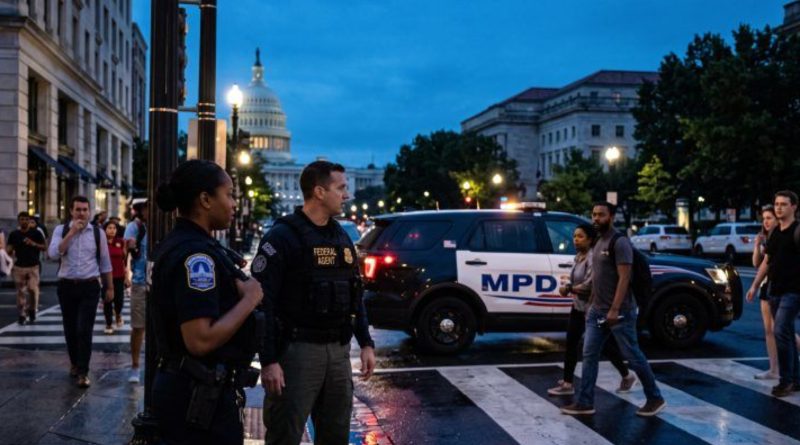
In a move that fundamentally alters the law-enforcement landscape of the nation’s capital, the Trump administration has aggressively widened the federal footprint in Washington, D.C., arguing that the city requires a robust, centralized answer to violent crime. Defying the District’s limited self-government, officials have thrust multiple federal agencies into explicit operational roles, pairing federal agents directly with Metropolitan Police (MPD) officers. The surge has led to tightened enforcement of federal firearms statutes and quality-of-life offenses, all coordinated through the newly established “D.C. Safe and Beautiful Task Force.” The stated goals are surgical: fewer violent crimes, increased prosecutions, and the assertion of a stronger sense of public order in a unique federal enclave over which Congress already retains unusual constitutional jurisdiction.
The operation, effectively bypassing traditional municipal structures, has polarized the capital’s distinct neighborhoods. For some residents, particularly in areas long beset by gunfire and open-air drug markets, the surge is not only visible but vital. Individuals who spoke to the Washington Post reported a tangible sense of relief, citing increased patrols, a sharp reduction in specific crimes like carjackings, and the perception that serious offenders are being incapacitated. Proponents of the administration’s strategy call the operation a long-overdue application of resources, insisting that federal agencies possess an implicit right and overwhelming interest in securing the effective seat of government. They point to recent Justice Department figures showcasing dramatic, double-digit, year-over-year declines in homicides, robberies, and vehicle thefts.
Yet, community advocates and civil rights organizations offer a starkly different diagnosis, characterizing the heavier federal presence as a profound infringement on local sovereignty. They warn that the operation has sown deep anxiety, particularly within immigrant communities already fearful of federal overreach. Critics also stress the profound confusion generated when multiple agencies-often with distinct mission profiles and use-of-force policies-simultaneously occupy the streets, making public accountability an opaque challenge. They maintain that the initiative blurs crucial legal lines between federal and municipal functions and critically stains the District’s hard-won, yet fragile, Home Rule Charter.
Federal Authority vs. Local Control
These mounting concerns have revived a potent, long-running debate over the governance of the District of Columbia. Legal scholars and historians point out that despite the city gaining an elected mayor and council decades ago, Congress never formally surrendered its substantial plenary authority over the capital. The central conflict, therefore, is not merely statistical. It is not an argument over criminal metrics, but rather a contest of power: who has the legal and moral authority to set local policing priorities? How should federal entities and municipal officials interact when jurisdictions collide? And how far can the administration push before Washington, D.C.’s experiment in local self-government is treated not as a right, but as an optional arrangement subject to the political will of the President?
The administration, dismissing critiques as ideological, emphasizes that its duty is to stop violence and protect all residents. “The first responsibility of government is to ensure the safety of its citizens,” an administration official said, speaking on the condition of anonymity to discuss sensitive operations. The focus, the official added, is strictly on criminal activity, not on the peaceful expression of civic life. Conversely, District officials have publicly questioned the long-term strategic viability of the operations, emphasizing that true public safety is organic and built through community trust, not external saturation. MPD Chief Pamela Smith, while acknowledging tactical cooperation, has consistently emphasized that her department is responsible to the citizens of the District.
As the Safe and Beautiful Task Force continues its high-visibility operations, officials, residents, and advocates alike are watching the metrics, but also the institutions. The definitive test, all agree, is whether the administration can win safer streets without fundamentally weakening oversight, eroding hard-won civil liberties, or irreparably damaging the city’s foundational claim to govern itself.