
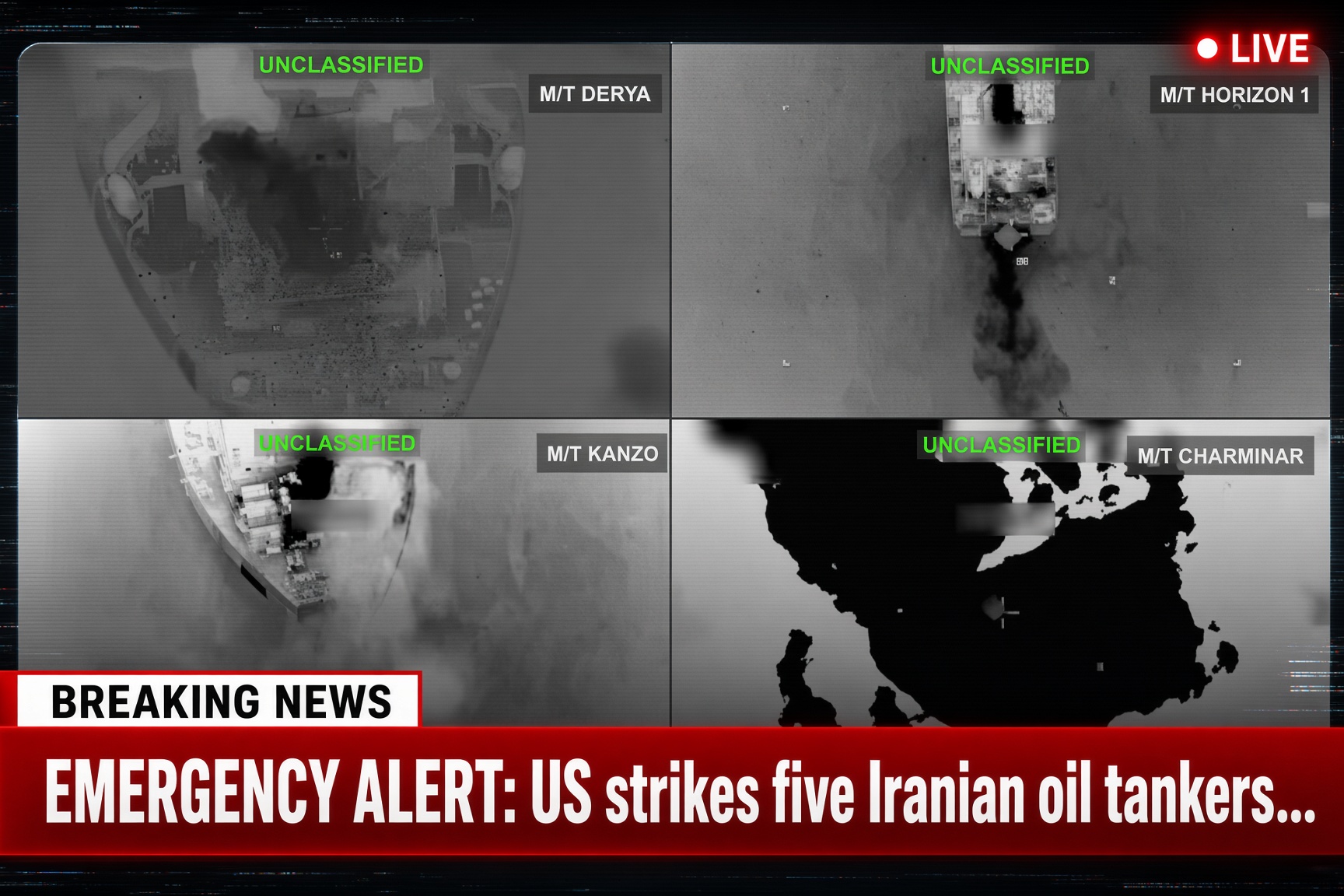
Iran says it has attacked 10 ships near the Strait of Hormuz after the US announced it sank five Iranian oil tankers in the Gulf of Oman and near Kharg Island. The US stated the sinkings were in response to Tehran launching ballistic missiles at a US warship.
Iran also fired missiles at US forces stationed at the Al-Azraq base in Jordan.
The exchange of fire overnight and Wednesday morning comes amid escalating tensions in the Gulf six months into the US and Israel’s war on Iran, with Tehran closing the Strait of Hormuz and Washington enforcing a naval blockade on Iranian ports.
The hostilities drove oil prices above $100 a barrel in early trading on Wednesday. Iran’s Foreign Ministry condemned the US attacks on its tankers, warning of the escalatory consequences.
“In response to the US’s aggressive actions against Iranian oil tankers, armed forces, in accordance with their inherent right of legitimate defence, attacked US military bases and facilities located in Jordan, which continues to support US military attacks against Iran, as well as several US vessels,” the ministry said.
In a statement late Tuesday, the US Central Command (CENTCOM) said Iran’s Islamic Revolutionary Guard Corps (IRGC) attempted to target a US warship twice over the past two days, but the vessel “successfully evaded the attempted Iranian attacks.”
“No American personnel were harmed,” CENTCOM added.
CENTCOM stated it responded by striking and destroying the Iranian oil carriers M/T Kaviz, M/T Charminar, M/T Horizon 1, and M/T Riesco in the Gulf of Oman, as well as M/T Derya near Kharg Island.
“American forces directed the crews to abandon ship before the vessels were struck and rendered inoperable,” CENTCOM said.
It later published a video showing the M/T Riesco sinking in the Gulf of Oman.
Iran Claims Attacks in Jordan and at Sea
The IRGC confirmed that five of its tankers were targeted. It stated it retaliated by subjecting the Al-Azraq base in Jordan to “fierce missile strikes,” claiming that hangars used by US fighter jets were destroyed.
The IRGC also claimed ballistic missile attacks on two US Navy destroyers—the DDG-119 and DDG-53—saying the strikes caused “significant damage” to both vessels.
In a subsequent statement, the IRGC reported that its naval forces targeted “two American vessels and eight tankers in the region, causing great damage.” It was not immediately clear if the two “American vessels” were the same destroyers mentioned earlier.
The US did not immediately comment on the Iranian claims.
The maritime strikes followed a warning from the IRGC of imminent attacks on oil tankers near the borders of Bahrain and Kuwait. The IRGC instructed all crews to evacuate immediately.
Additionally, the IRGC declared that a restricted maritime zone would extend from Chabahar into parts of the Gulf of Oman and the Arabian Sea, with precise coordinates to be announced later.
This follows comments on Sunday by Mohsen Rezaei, secretary of Iran’s Supreme National Security Council, stating that Iran would establish a restricted zone outside the Strait of Hormuz.
Later on Wednesday, the United Kingdom Maritime Trade Operations (UKMTO) reported an attack on a cargo ship off the coast of Iraq. The vessel was hit by a projectile 52 km (28 nautical miles) southeast of al-Faw, Iraq.
Meanwhile, the Jordanian Armed Forces stated its air defenses engaged 20 incoming ballistic missiles, “successfully intercepting and destroying 18 of them,” while two fell in unpopulated areas.
The military added that the attacks caused no casualties, and specialized teams were dispatched to secure the locations where debris and shrapnel fell.
Earlier, Ali Abdollahi, Chief of Staff of Iran’s Armed Forces, warned that Tehran would strike US military installations across the region if Iranian tankers were targeted.
Accusations of War Crimes
The US previously attacked three Iranian oil tankers on September 5, sinking one. Tehran responded the same day by targeting three commercial ships and three US-linked vessels.
On Tuesday, Iran’s Ministry of Foreign Affairs condemned the latest US attacks on Iranian commercial vessels as a violation of the United Nations Charter, calling them a “war crime.”
The ministry labeled the actions a continuation of US military “aggression” and “economic war,” warning that Washington and its partners bear full responsibility for the consequences.
US Secretary of State Marco Rubio defended the strikes during a visit to Colombia, emphasizing that Washington would not back down. “Iran continues to try to hit US naval ships, and every time they do that or try to do that, they’re going to lose tankers,” he told reporters.
Reporting from Washington, DC, Al Jazeera’s Mike Hanna noted that the attacks mark a clear escalation in the six-month conflict.
“The US is now finding new targets in response to Iranian attacks, or what the US administration says are Iranian attacks,” Hanna said. “Whether these tanker attacks are part of a broader strategy or a matter of circumstance remains unclear. However, these strikes will undoubtedly exert economic pressure on Iran, aligning with Washington’s stated strategy of economic strangulation.”
Also on Tuesday, the IRGC claimed it captured an unmanned US submarine at the entrance to the Strait of Hormuz during a “complex intelligence and operational action.”
However, the US military stated the submersible drone had simply “malfunctioned” while surveilling regional waters, adding that the defective drone carried no sensitive data or classified sonar and radar equipment.