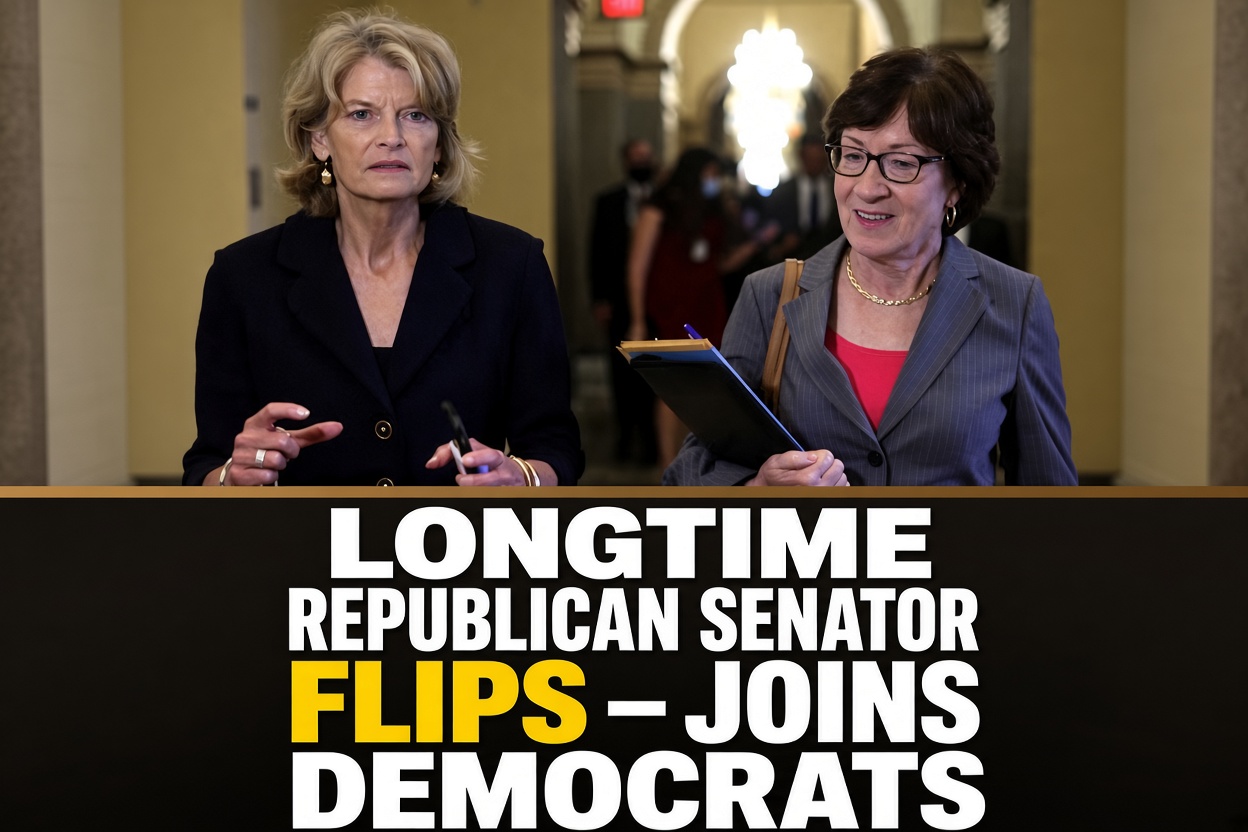
Longtime Alaska Sen. Lisa Murkowski stunned conservatives this week by endorsing a Democrat for governor over three Republican contenders.
Her decision supports former state representative Jonathan Kreiss–Tomkins, who is seeking to succeed term-limited Republican Governor Mike Dunleavy.
President Donald Trump has instead endorsed Republican Bernadette Wilson, creating another public disagreement with the senator.
Murkowski announced her endorsement during an interview with Anchorage television station KTUU ahead of the November election.
She praised Kreiss–Tomkins as a pragmatic politician capable of working across partisan divisions in Juneau.
“Our future is too important to be hamstrung by partisan divisions,” Murkowski said in her endorsement statement.
She argued Alaska needs cooperation on fiscal challenges, energy costs, and economic development rather than political conflict.
Kreiss–Tomkins welcomed her support and emphasized cooperation with lawmakers, industry, and communities throughout the state.
Republicans Wilson, former Anchorage Mayor Dave Bronson, and former Attorney General Treg Taylor are competing against him.
Alaska’s ranked-choice system permits voters to rank candidates, making second preferences potentially important during ballot tabulation.
🚨 WOW: “Republican” Sen. Lisa Murkowski waited until a week before Election Day to endorse Democrat Jonathan Kreiss–Tomkins for Alaska governor. “For whatever it’s worth,” she says.
Nothing, Lisa. It’s worth nothing. https://t.co/Ym3KvdUkAh
— DeVory Darkins (@devorydarkins) October 28, 2026
Dunleavy urged Republican voters to rank all three Republican candidates rather than divide their support.
Trump endorsed Wilson during an October 13 appearance in Wasilla, seeking to consolidate conservative voters behind her campaign.
Wilson responded sharply to Murkowski’s decision, criticizing the Democrat’s positions on taxation and permanent fund dividends.
Polling nevertheless shows Republicans face a difficult contest despite Alaska’s longstanding preference for Republican presidential nominees.
A New York Times and Siena survey placed Kreiss–Tomkins ahead of his three Republican competitors.
The survey reported 46% support for the Democrat, with Wilson at 24%, Bronson 17%, and Taylor 13%.
Trump carried Alaska in 2024, illustrating the state’s conservative presidential voting history.
Murkowski’s endorsement therefore highlights divisions within Alaska’s Republican establishment rather than an overall statewide ideological reversal.
Her father, former Republican senator and governor Frank Murkowski, also endorsed Kreiss–Tomkins alongside two former governors.
Kreiss–Tomkins previously served a decade in Alaska’s House, including representing a district that supported Trump.
Murkowski has crossed party lines before, including supporting Democrat Mary Peltola’s House campaigns.
Peltola lost her 2024 reelection bid to Republican Nick Begich, demonstrating that Murkowski’s endorsement does not guarantee victory.
Murkowski has endorsed Republican Senator Dan Sullivan’s reelection campaign this year despite Peltola’s Democratic challenge.
Trump recently attacked Murkowski after she questioned a federal lawsuit involving Alaska’s Senate ballot certification.
The president described her as a “DISGRACE” and criticized her resistance to his preferred approach.
Their disagreement extends beyond Alaska’s gubernatorial contest into national questions about party loyalty and election administration.
She was among Republicans who rejected his conduct surrounding the January 2021 Capitol attack.
Her independent positioning has helped her attract crossover voters while repeatedly frustrating conservative activists.
In 2010, Murkowski lost the Republican Senate primary but won reelection through a historic write-in campaign.
That victory demonstrated her personal electoral organization could survive without the party’s formal nomination.
She subsequently won additional Senate terms, including reelection under Alaska’s newer election rules in 2022.
Conservatives nevertheless see the latest Democratic endorsement as another reason to seek a different Republican senator.
Murkowski’s current Senate term ends in January 2029, placing her next regularly scheduled election in November 2028.
Federal Election Commission records already identify Murkowski as a Republican candidate for the 2028 Senate contest.
Her federal committee reported approximately $2.07 million in receipts through September 30, 2026.
The same filing showed approximately $1.56 million in cash available and no outstanding committee debt.
Those disclosures indicate an active campaign organization but cannot guarantee she will ultimately remain in the race.
Her recorded party affiliation is Republican, and no verified announcement establishes a switch to independent status.
Whether she ultimately seeks reelection under that label could become a major question for Alaska conservatives.
Alaska’s voting system could also affect how competing Republican and independent candidates advance and accumulate preferences.
Her 2028 political future remains open to voters, potential challengers, and her own subsequent decisions.
This article may contain commentary which reflects the author’s opinion.