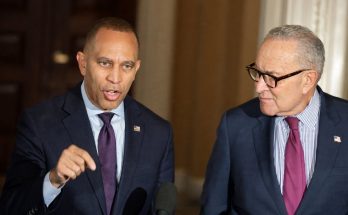
Chuck Schumer faces a potential challenge from socialist activists, with activists reportedly discussing an alternative candidate for his Senate seat.
Brooklyn Councilman Chi Ossé could challenge the Senate Democratic leader in 2028 if Alexandria Ocasio–Cortez instead pursues the presidency.
The reported scenario highlights another internal Democratic struggle, as younger left-wing politicians question whether established leaders should remain in charge.
According to the September 19 report, Democratic Socialists of America sources described ongoing discussions about supporting Ossé for Schumer’s seat.
The account outlined political maneuvering rather than an announced Senate campaign, and Schumer had not confirmed retirement rumors.
Ossé’s visits to Buffalo and Kingston supplied the backdrop, with the councilman delivering remarks suggesting interest in broader political influence.
At a Mid–Hudson Valley DSA event in Kingston, he rejected the notion that younger politicians should patiently await advancement.
“I think the era of wait-your-turn politics is over,” he told the audience at Unicorn Bar.
“The time for us, the socialists, is right now,” he added, according to reporting attributed to Hell Gate.
Ossé, described in the article as 28, also advocated government-run electricity and greeted attendees before the public discussion.
Those appearances matter because a statewide campaign would require reaching voters well beyond the Brooklyn constituency he represents.
The report said several DSA sources confirmed talks about running him against Schumer, whose Senate term ends in 2028.
New York Assemblywoman Sarahana Shrestha, who also spoke at the Kingston event, directly criticized Schumer’s connections to the technology industry.
Shrestha belongs to the DSA’s Mid–Hudson chapter and argued that socialists should lead efforts confronting large technology companies.
Her criticism targeted moderate Democrats as well, illustrating that the disagreement extends beyond one prospective candidate’s ambitions.
She also discussed efforts to persuade Ocasio–Cortez to pursue the White House, describing an active campaign within the organization.
“DSA is openly trying to convince AOC that she should run,” Shrestha said.
That statement described activists’ preferences, rather than an announcement from Ocasio–Cortez that she had decided to enter a presidential race.
The report also discussed potential personal costs of a presidential campaign, which Shrestha characterized as a serious consideration.
Ossé did not answer the Post’s calls, according to the article, but avoided dismissing Senate speculation when questioned elsewhere.
He criticized current Democratic leadership and argued that electing socialists was necessary to confront what he described as fascism.
“I don’t believe that our current Democratic leadership is standing up to the plate,” he said.
“A lot of people are calling for change.”
The prospective challenge would follow another confrontation between Ossé and a senior Democratic leader, House Minority Leader Hakeem Jeffries.
Ossé previously abandoned a congressional campaign against Jeffries after the effort generated conflict within the Democratic Socialists of America.
According to the report, Mayor Zohran Mamdani urged the organization to stop the bid over concerns about his agenda.
The article said Mamdani and Ossé had repaired their relationship, although the episode demonstrated divisions within the socialist movement itself.
That history complicates any assumption that left-wing activists would automatically unite behind another campaign targeting an established Democratic leader.
Ossé’s record would also face scrutiny, including his support for New York City’s controversial prohibition on certain broker fees.
The article highlighted his past comments about Israel, race, religion, and political leadership as potential vulnerabilities in a broader contest.
Veteran Democratic consultant Hank Sheinkopf questioned whether the councilman could translate his city political profile into a successful statewide campaign.
Sheinkopf predicted opposition from Jewish voters and business interests, offering a critical assessment rather than a demonstrated election outcome.
“Statewide races are tough, they’re entirely different than working in the city,” he told the Post.
He characterized Ossé’s activities as exploratory, comparing them to testing whether a candidacy could attract support without encountering overwhelming resistance, The New York Post reported.
The report also contrasted Ossé’s socialist messaging with his private-school education and appearances alongside celebrities at prominent social events.
This article may contain commentary which reflects the author’s opinion.